Fresh snow has arrived in not-insignificant volume all the way down to the valley floor. We woke up this morning at 900m altitude to a good 30-40cm of fresh powder. It has kept snowing lightly throughout the day, although the freezing point has ascended slightly, meaning that below about 1000-1200m it has been a bit wetter.
There’s no doubting that this offering of snow constitutes a decent ‘dump’ that has generously covered the lower slopes of all the surrounding ski resorts and significantly boosted the high-altitude snow depth.
First thing today, Les Arcs (official) was heralding 35cm of fresh snow in Arc 2000, with the 0°C isotherm hovering around 1450m (although I think that’s a little bit conservative, as the highest temperature I saw at 800m today was only 1°C…) Overall, snow depth in Arc 2000 is reportedly 70cm, which is a solid start in November.
La Plagne’s morning figure was 36cm of new snow at 2000m, making an overall total of 63cm.
The official number is Tignes is 30cm of fresh snow at 2100m, and 40cm at the sky-scraping 3300m peaks. This translates to 53cm snow depth at the lower level, and a (very exciting) 170cm at the upper echelon. With Tignes already open to the paying public, this extra powder might help open a few more pistes over the next couple of days. Across the ridge, Val d’Isere is reporting an overall snow depth of 60cm at 1800m, and 80cm at 3000m (although I’m not convinced that these number have been very recently updated).
Sainte Foy, which can be a bit slower to update their recent snowfall, is showing that 20cm fell yesterday (27th Nov) giving an overall snow depth of 50cm in resort, 130cm at the Arpettaz (2100m) and 140cm atop the Col de l’Aiguille (2650m). However, these are “fresh snow” numbers, so we can assume some settling will occur.
La Rosiere have clearly not quite woken up to the winter yet, so I have no official figures, however we can assume they are very similar to the other resorts mentioned.
Typical of early season weather, there is likely to be further precipitation over the next few days (until around Saturday) but, with the freezing level moving up and down like a whack-a-mole, there’s likely to be sleet and rain mixed in with the snowfall. It looks like everything above 2000m should make a net gain, but below that point there could be some ‘settling in’ and, on the lower slopes, even some melt-back. Whatever happens, this first proper dump is good news and makes it feel like true winter is getting a grip.
Jeffrey Combs, the actor who played Herbert West in yesterday’s film Re-Animator, is described by Time Out as ‘the thinking man’s Bruce Campbell.’ This had no bearing on The Evil Dead (1981) being today’s choice of film, it was simply (spooky…) coincidence.
The Evil Dead seems to be a bit of a strange film in that The Evil Dead 2 is apparently the better movie and is also less of a sequel than a slight reworking of the original to avoid apparent rights issues. That said, The Evil Dead does manage to get on Time Out’s list. I decided to go for the earlier one which is not quite the paradigm of horror-comedy that the ‘sequel’ is purported to be, but is still well respected as vaguely amusing and gory.
It’s not great. The fairly amateurish, homemade look is apparently part of its charm, but it’s just a bit basic. In many ways it treads a similar path to Re-Animator, with a reliance on gory, shock-filled special effects, but it’s not as satisfyingly wacky or amusing.
Look at her eyes. Look at her eyes! For God’s sake, what happened to her eyes?
What are the best bits (intentionally-vague slight-spoilers)? It’s not the worst film I’ve seen this month. I noticed that Joel Coen (THE Joel Coen) was the assistant film editor. The breadth of special effects used is impressive, even if they’re not particularly realistic. There’s so much fake blood. Some of the camera shots seem truly innovative. The tree special effects, and the woodland sexual assault as a whole, was impressive in its unexpectedness, although I’m not sure you can really describe it as “good.”
What are the worst bits? The sound of the ‘evil dead’ is generally quite annoying, from their screaming to laughing. It’s all a bit jarring, and not in a psychological way. The acting’s not the best, with the Scott character being the truely lowest common denominator. Most of the film is quite predictable. It’s just a bit incoherent and not as fun as it could be. It “goes on a bit” despite being less than 90 minute long.
Do you wish you’d watched The Evil Dead 2 instead? A little bit. Yeah.
Today’s movie just managed to sneak into the Time Out Top 100 horror films and it is as madcap and grotesque as advertised. Another product of the apparent eighties horror boom, Re-Animator (1985) is filled with gore, wackiness and crazy characters. It’s largely about two medical students in an American university: the first one, Dan, is pretty straight-laced, the second one, Herbert, who becomes Dan’s roommate is a complete loose cannon. Essentially Herbert has been transferred in from Germany, is generally very odd and seems to have figured out how to “re-animate” dead things.
It contains all of the hallmarks of a good eighties film, or a good horror film, or a good eighties horror film; it’s gruesome, silly, unpredictable, the special effects are outlandish (check out the fluorescent re-animating serum), there’s gratuitous nudity aligned with gory/hilarious sexual practices, and an ending that is predictably unpredictable.
“Cat dead. Details later.”
What are the best bits (intentionally-vague slight-spoilers)? So many special effects. The whole Herbert West character, who is a fantastic anti-hero. It cracks along. It manages to take some recurring motifs that are typical of film/storytelling and inverts them (I’m thinking of the resuscitation scene amongst others). There’s a really nice Frankenstein vibe.
What are the worst bits? People still make strange decisions about the best course of action to take in any given situation, but the whole film is strange, so that makes it ok. It doesn’t suffer from an adherence to reality.
Have you learned anything else about horror films recently? I feel like the last few days/films haven’t added much to my general knowledge or insights, into horror films as a genre. Sadly, it feels like I’m beginning to form a rough estimation of what to expect, or what I might ‘prefer’ when it comes to horror. This may be due to some sort of horror ‘fatigue’ from spending every evening watching a new film, many of which rely on gore, or shock value, to carry a thin story. Unfortunately, whilst there have been instances of gore (or at least impressive special effects) that I’ve enjoyed, I do seem to struggle with ‘shock.’ I think the most impressively ‘shocking’ scene I’ve seen so far might be towards the end of Hereditary, but I can’t say it was particularly scary or unsettling.
So are horror films about being scared? I think that maybe they’re not and that might be something I’ve learned over the month. Scary films do not have to be scary, or at least not for everyone. Horror, therefore, cannot be judged purely on their ability to frighten or even disgust as, certainly from my subjective viewpoint, that’s pretty difficult to achieve with fictional (and generally unlikely) scenarios. The movies I’ve enjoyed most so far haven’t tried too hard to be frightening or clever. There may be a little more to learn, but I think I’m mostly going to be relieved when this is over…
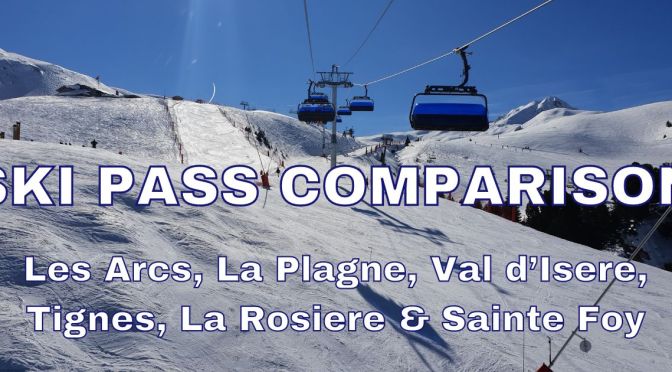
There is a huge variety of ski passes available across different ski domains and which pass might be best for you is not necessarily the ‘6 day’ standard. This is therefore just a very basic comparison of the most popular Paradiski (Les Arcs & La Plagne), Val d’Isere/Tignes, Sainte Foy and La Rosiere passes. For more information, and options, check out the specific pages for each ski resort.
Ski Area
1day adult
1day child
6day adult
6day child
KM pistes
Over 2000m
Paradiski (Les Arcs & La Plagne)
70
56
369
296
425
70%
Les Arcs
65
52
330
264
200
70%
La Plagne
65
52
330
264
225
70%
La Rosiere (San Bernardo)
55.5
41.5/ 50*
279
209.5/ 251*
154
Tignes & Val d’Isere
66
56
396
336
300
60%
Sainte Foy
38
32
228
204
43
The reduced price for seniors (65-74 years old) is the same as the prices for children, except in La Rosiere, where the seniors price is marked *
This is just a very basic table and, as mentioned, there are a variety of factors which affect (and complicate) even these basic ski pass prices…
Children
Ski resorts do not have a standard age range when it comes to classifying a person as a child. This means that visiting certain domains is more cost-effective depending upon the age of your child(ren). In Paradiski (both Les Arcs and La Plagne), and in La Rosiere, the reduced rate for children applies to kids between 5 & 12 years old. Under fives get a free pass. Sainte Foy considers children to be aged 8 to 14 years old (under 8s go free). Tignes & Val d’Isere are somewhat exceptional in that ‘child’ covers 8 to 18 year olds, meaning you only have to pay full price once you hit 19!
Whilst the Val d’Isere/Tignes child classification would seem to be cost effective for teenagers, the “reduced” price is more expensive than an adult price for Les Arcs, so you’re actually still spending more money. The real benefit with Val d’Isere & Tignes is when you have lots of kids aged 7 or under, as they are effectively getting a free ski pass… which goes a little way to ameliorating the increased adult price you will be paying (plus the general common expenses associated with staying in Tignes or Val d’Isere).
Similarly Ste Foy’s beneficial age shift can reduce overall cost, although Ste Foy is simply a cheaper option anyway.
Free days on a 6 day pass
Because a 6 day pass is essentially the industry standard (skiers generally stay for a week), some ski passes have “bonus time” on their 6 day passes, to entice you to ski the day you arrive (or leave). The full Paradiski 6-day pass gives you a free afternoon (half day) on the day before your ski pass starts (essentially allowing you to start your holiday early, but not finish late). The full Tignes / Val d’Isere pass gives you a full seventh day (you effectively cannot buy a 6 day pass, you can either get 5 days, or 6+1). It’s the same at Sainte Foy: you pay for six days, you get seven days. These offers are great if you have the time within your travelling schedule to use them (particularly useful if you are driving or getting an early (on arrival) or late (on departure) ski train).
Value per KM of piste / altitude
Going from the figures alone, you get a lot of kilometres of piste per euro in Paradiski, whereas the lower price of Ste Foy gives you only a limited area in which to ski. Other than the size of the area, you might be considering altitude as a key factor in choosing a ski resort. However, on both these points, the numbers are not the “be all and end all.”
Paradiski is HUGE and, in a week, it’s pretty difficult (and questionably worthwhile) to cover the whole domain. This can be exacerbated by where you choose to stay; the full Paradiski area is much more accessible from Peisey-Vallandry or Montchavin (which are close to the adjoining Vanoise Express gondola), than from Montalbert or Villaroger (at the far ends of La Plagne and Les Arcs respectively). The situation is similar in Tignes/Val d’Isere as, whilst it doesn’t have a one-gondola connection between the two main domains, it is quite linear, making getting from one end to the other quite an endeavour. Another thing to consider is snow, as heavy snowfall can make getting about less straightforward (due to trickier conditions and closed lifts). Also, heavy snow makes it more sensible to stay in one place to enjoy the fresh powder, rather than try exporing in sub-optimal conditions. For most people there is therefore a limit to how many kilometres of piste you actually NEED.
Another thing is off-piste. Sainte Foy may not have a lot of groomed pistes compared with the others, but it has a high proportion of adjacent, accessible (and often underused) off-piste. So if off-piste is your thing, the KM of groomed runs on any given ski area may mean next to nothing.
Lastly, altitude. It can be important, but sometimes it’s not. If it’s snowing everywhere, at all levels, then it can be more important to be in a place with enclosed lifts which are not exposed to high winds and a good proportion of tree runs. In late season, it can better to be on the lee-side of the mountain (away from the sun), than at a higher altitude. Finally, people have a tendancy to “get high” meaning these areas are often the busiest and that there is actually more fresh snow to ride lower down.
Other things to consider
The Sainte Foy prices are somewhat ‘dynamic’ meaning some days/weeks are cheaper than others. The prices displayed in the table above are the most expensive, but you’re really only ever likely to save a couple of euros per day on the standard dynamic prices.
Saturday’s are often cheap, so if you just want to add on a day, that can be a cost-effective way of doing so. Sometimes you have to book in advance (the day before) or specifically online (maybe with a code), but find out beforehand and you’ll be well equipped for some last-minute pow.
Also, it can be simply cheaper to book online and some ski resorts (mostly outside of the Tarentaise in my experience) can put up short-term deals at times.
As mentioned at the start, a 6 day pass might not be for you. It may be cheaper (and more flexible) to pay as you go (PAYG) or pick and choose which days (and even ski areas) you ride as you go along. There are even cross-resort single ski passes which let you ride where you like at maximum convenience. It’s always best to check out all your options before you head out to the mountains.
I’m not sure where this next film came from, or if it had anything to do with the fact that the main female protagonist as the same surname, Kessler, as the main male protagoninst in An American Werewolf in London… It’s the modern-day slasher/body-swap comedy-horror-thriller called Freaky (2022). It jams together the general premise of the Freaky Friday films with an old-school face-mask-wearing slasher murderer preying on school-age teenagers.
It is great fun. It’s a bit silly. There are genuine moments of horror and surprisingly good tension-building at various times. The acting of the two main characters, Vince Vaughn and Kathryn Newton, is great and it doesn’t take itself too seriously.
Don’t underestimate a straight white man’s propensity for violence Isaac, I don’t care how fucking old they are.
What are the best bits (intentionally-vague slight-spoilers)? The acting is great. The overall premise introduces new avenues of jeopardy for our favourite characters, apart from the standard slasher/murder/death angle. There’s some very fun, innovative and gruesome deaths right from the beginning. There’s certainly enough gore and uncomfortable moments to qualify it as a horror, despite being a bit silly at times. The ‘first kiss’ scene is at once brilliant and absoutely terrible.
What are the worst bits? It is a bit silly, but it’s supposed to be, so that’s not a major criticism.
Is it a great horror film? It’s not a great horror film. However, it is a good and enjoyable film, which combines a clever take on a couple of horror sub-genres whilst providing pretty accomplished gore and suspense moments.
John Landis directed National Lampoon’s Animal House, The Blues Brothers and then, our next film, An American Werewolf in London (1981). The special effects were created by Rick Baker, who won his first Oscar for them (he has since won 6 more and been nominated 5 other times!) The film also features Jenny Agutter, Brian Glover, Frank Oz and, in a tiny non-speaking role, Rik Mayall. For once this is a highly-rated horror film that delivers. Hooray/finally!
It’s not the scariest film, but it’s certainly not the least scary either. It’s great fun and the story goes along at a decent pace. It really quite funny in places and overall there’s a lot to enjoy.
Benjamin, have you ever been severely beaten about the face and neck?
What are the best bits (intentionally-vague slight-spoilers)? The special effects are great; particularly the variations on Jack and the transforming werewolf. You know the special effects are great because they are often shown in full light and don’t have to be obscured by dark or dingy light to smooth the edges. It’s really quite amusing with even the film-within-a-film “See You Next Wednesday” being really quite funny (as well as bringing some horror-standard gratuitous nudity).
What are the worst bits? The actual “full” werewolf is the weakest special effect, but it’s still not terrible. The narrative is not particularly believable (the actions of the doctor, the main nurse and all the people who want to crowd around the werewolf seemes unlikely) but that’s not massively important, because the movie isn’t taking itself too seriously. The film doesn’t include Warren Zevon’s hit Werewolves of London, which is a shame.
The next film is another exercise in taking the day-to-day and pointing out that it is frightening. I tell you what’s scary: pregnancy. I tell you what else is scary: old people. It’s Rosemary’s Baby (1968), another undisputed great in the pantheon of horror classics…
This film has clearly informed and inspired pletty of horror films hence. The earlier-watched Hereditary (which wasn’t too bad at all), is essentially the same story approached from a slightly different time point; it could easily be a reboot, or at least some sort of sequel. There are also some similarities with Suspiria (which was too bad at all) and maybe also The Exorcist. Unfortunately, despite the fact that unsettling horror is “a gimme” when dealing with non-straighforward pregnancy, the film is somewhat predictable, weirdly-acted, boring and not-scary-in-the-least. For my taste, like so many other horror movies, it loses much of its ability to be frightening or unsettling because the characters are so wilfully stupid, or at the very least difficult to empathise with, that you feel apathetic towards their fate.
And it was kinda fun – in a necrophile sort of way.
The only character that we might really care about is Rosemary (played by Mia Farrow) and any disquiet we might feel comes from her experience of pregnancy, entwined sense of isolation and uncertainty over her grasp of reality. Again, it is disappointingly difficult to empathise with her character because, on the whole, she comes across as rather stupid and a bit “wet.” Now, there are plenty of reasons why one could forgive Rosemary for her general demeanour (SPOILERS FOLLOWING)… perhaps most prominantly there is clearly witchcraft afoot, which is capable of making people blind/suicidal/evil and could be a broad-brush explanation for her general lack of agency or intelligence at key moments. Secondly, she does not have a sympathetic character upon whom she can rely, so is very much alone in her situation. Thirdly, there’s widespread drugging (although this might fit in with ‘witchcraft’ above)… This leads us to ‘fourthly,’ and perhaps from a non-supernatural psycholgical viewpoint, ‘most importantly’ she is in the worst kind of abusive and coercive relationship. Her husband, Guy (played by John Cassavetes), is an absolute DICK and certainly the most loathsome person in the film (who commits the most heinous act, which he explains nonchalently as a different but possibly-equally-heinous act). There are therefore many reasons why one could forgive Rosemary her general lack of backbone, but it doesn’t make her particularly likeable, and thus when the completely predictable happens (which is effectively everything) it’s hard to feel either way about it, or her, or the film as a whole.
It’s definitely a horror though? Well there are demons, an intimated (if not at all misleading) twisting of reality, witchcraft, unexplained blindness/comas/death, gratuitous nudity and an complete absence of anything you might describe as frightening… so probably yes. Also, it’s massively underwhelming and, to my mind, overrated (#7 Time Out, #11 Empire, 8.0 on IMDB!) so, once again, probably a horror.
What are the best bits (intentionally-vague slight-spoilers)? Mia Farrow does an excellent job of acting pathetic. A pregnant woman drinking loads and being surrounded by smoking people is particularly fun in the 21st century. Hutch is a likeable character.
What are the worst bits? Some of the dialogue, or exchanges between characters, is difficult ot listen to… particularly any time Guy speaks and thinks he’s funny, or when Rosemary has a brief conversation with Terry Ginofrio in the laundry room. It’s difficult to understand why Rosemary does anything, she is like basic flotsam. The things which could be utilised to ramp up some tension or sense of disconcertion… pregnancy, the horrendous, coercive actions of the husband, the inherent creepiness of unnecessarily friendly (elderly) neighbours… is underused or perhaps so dilute as to be aromatherapy-levels of ineffective. There’s some vague commentary about satanism and catholicism, although I’m not sure why, or what the point was, if any. It goes on a bit.
You’re surely missing the point, isn’t this one of the best films (not jsut horror) of all time? Apparently so. I am a great believer in reading/watching/listening to the classics, to better understand the roots of cultural artifacts, enjoy the originals as they were first presented and generally get to grips with the development of storytelling/films/music/etc. However, I do feel like horror films (or even films of certain eras if they were sufficiently critically-acclaimed/popular in their time) or sometimes ‘given a pass’ when the storyline is inconsistent or they have narrative flaws. I’m not saying that joining Roman Polanski, Mia Farrow and John Cassavetes in transmuting a then-very-popular novel into film, whilst adding a strong dose of then-risque satanism, nudity and subversion of domestic norms, is sufficient to make a film heralded in the highest regard (a position it has never really relinquished), despite it being widely defective… oh wait… that IS exactly what I’m saying.
In some ways following the same general premise of The Texas Chain Saw Massacre, with a young woman being terrorised by crazed criminal redneck types, the next film I watched was more horrifying but whilst it probably had more consistent plot, better acting and higher production values than Texas Chain Saw, whether it’s a “better film,” or certainly whether it is a “better horror film,” are difficult questions. It’s I Spit on Your Grave (1978) which has since seen remakes and sequels.
This film is horrific, there are genuine moments of suspense and a sense of imminent peril throughout. The problem I struggle with (and there are spoilers here) is that the “horror” is based on repeated sexual abuse of the main protagonist, who repeatedly tries to escape a group of redneck rapists, only to be brutally beaten and raped by them. Now, when it comes to slasher films, with blood-splattering murder, unlikely weapons (chainsaws, hammers, kitchen knives being used from the elbow…) and characters making poor life choices resulting in their gruesome demise then, in a weird way, it seems more harmless. Somehow, helpless young people being slaughtered seemingly at random is much less horrific than a young person being repeatedly sexually abused then murdered (although, for the story to conclude, the murder doesn’t happen). Following all of that, the woman then proceeds to take bloody revenge on all of them, which feels more like a horror, but in no way removes the unsettling feeling that the whole thing is not really entertainment.
A lot of horror films have gratuitous nudity. That seems to be an industry standard that I’ve commented upon earlier in the month. Jennifer (the heroine) in I Spit on Your Grave probably spends more of the film naked than not, which would fit with the genre generally if it wasn’t for all the sexual and related non-sexual violence she suffers. Even if someone tried to argue that the nudity wasn’t exploitative in the first part of the film, in the second (revenge) part, Jennifer not only gets naked with one of the original perpetrators as part of her revenge plan, but actually has sex with another one… all for apparently no good reason. She has ample opportunity to shoot her rapists (she has a gun at this point), yet does something a lot more elaborate, inherently illogically risky and personally degrading… presumably because it means the actor can spend more time naked on-screen. It’s not great.
I have no friends because of you.
It’s definitely a horror though? I’m not sure. If the first half was different (maybe the men killed her family/friends in a classic slasher way or perhaps if there was less gratuitous abuse), then the second half would definitely be a horror film, because the gratuitous nudity, odd decision-making and general elaborately constructed gore-scenes would be more acceptably entertaining. Again, I struggle with what a horror film “is,” but there’s something about this movie that makes me feel like it “isn’t” (at least in parts).
What are the best bits (intentionally-vague slight-spoilers)? There’s a whole interaction where one of the men essentially explains his actions to Jennifer by victim-blaming her, which may have been ahead of its time in terms of social commentary. Some of the acting was good (Camille Keaton in murder-mode is a particular highlight).
What are the worst bits? There are no winners in this game. The whole premise of the film does not make the bloody revenge seem as euphoric as you’d hope. It’s all pretty grim. In the second half, the protagonist (with respect to horror movie tradition) does make a series of odd/bad decisions, but unhappily they just seem invited to blur the line further between entertainment and sexual violence. You feel like this is definitely not the sort of thing that would get made now.
But what about the 2010 remake… and sequels? It might be interesting to know what a modern version of this movie looks like, but I’m not sure that curiosity is enough to make me find out.
A few time on this journey I have watched a film which was so rubbish that writing about it seemed an even further waste of my time. Hoping to forget yesterday’s low-budget disappointment, and following relatively closely to Halloween (which I surmised was alright as films go), today was time for another classic slasher, similarly highly rated, and spawning a similarly high number of sequels, prequels and reboots. It’s The Texas Chain Saw Massacre (1974) (or The Texas Chainsaw Massacre, not sure which one is right).
Spolier alert: it’s rubbish.
It deals with the standard slasher set up of young people ending up somewhere, then getting murdered one by one. There’s a slight twist on who the killer is, but it’s mostly a plotless, low-budget pile of nonsense which involves a lot of screaming. It seems to follow the old horror adage that the American countryside is terrifying and full of criminally crazed redneck types. There’s a lot of abattoir talk.
My family’s always been in meat.
Everyone is killed with a chainsaw? You would think that wouldn’t you.
What are the best bits (intentionally-vague slight-spoilers)? I can’t think of a single thing. To be honest, it was a struggle to keep watching it, let alone care about what was going on. The killer, leatherface, is big.
What are the worst bits? The fact I had to watch it, closely followed by the fact that it is considerd one of the high-points in horror movie making.
Anything else to say? After 21 films, including a large number which have very good IMDB ratings or otherwise are highly valued in the genre, I believe that whilst there are good horror films, the vast majority are bad or truly awful. The graph from ‘Excellent’ to ‘Truly truly awful’ would apparently rise exponentially from a quite flat, x-axis-hugging start.
Halloween had one guy in blue overalls, some decent acting, a reasonable runtime, a surprising lack of gore and a coherent storyline. Today’s film had lots of guys in blue overalls, terrible acting, an excessive runtime, lots of rubbish gore and an veritable surfeit of nonsense. Whilst Dawn of the Dead (1978) was made in the same year and still features high up on lists of the best horror films, it is just so, so awful. It thinks it’s an action film. There are zero redeeming features. After a handful of acceptable, even borderline enjoyable movies, this is horror films back on form: shit, pointless and a massive waste of life.
Dummies! Dummies! Dummies!
What are the best bits (intentionally-vague slight-spoilers)? There’s an attempt at gentle humour, regarding the behaviour of the zombies and some satire on how people, and the media, would react to a full-on zombie apocalpyse. However, this is disjointed and not very clever or funny. Some of the music is fun.
What are the worst bits? The acting is rubbish. Painfully so. The zombies have blue faces like smurfs, and are rubbish. Actors are used multiple times, with little attempt to make them seem at all different. There’s a lot of gore, but it is rubbish: the blood is like red oil paint. It is far too long and feels even longer than that. Nothing makes sense. The zombies are useless, but are fortunately faced with even more useless human beings. Name anything you might find in a film, and it will be rubbish in this. At one point someone tries to hit a zombie with a hammer and they just fall into each other; it would be funny but it’s just sad. The ending is completely unsatisfying.
Anything else to say? No. I want to forget I ever watched that film now please. Just don’t watch Dawn of the Dead. You have been warned.


 XIST
XIST 