
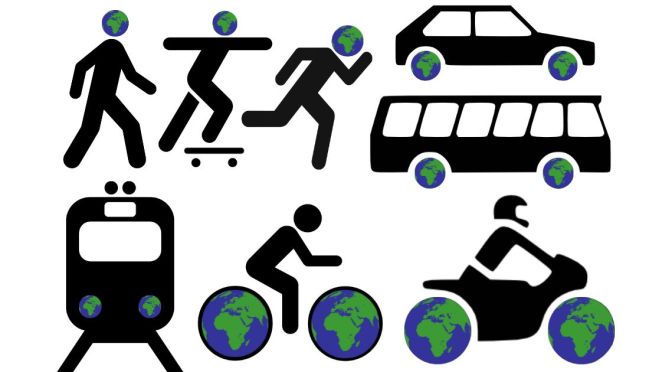
Humans are moving all the time. Unfortunately, we seem to be pretty inefficient when it comes to moving ourselves about. One good example is cars. Oftentimes, when we want to go from A to B, we consider the most straightforward means to involve taking over a tonne of metal, plastics, rubber, electronics and soft furnishings with us. This has all been made possible by the internal combustion engine. Because we can move a huge amount a material with no effort, people have become insensible to the fact that using massive vehicles to carry individual human beings (which might weigh less than 5% of the overall load) is MADNESS! Obviously the degree of madness is variable according to where a person is going, what (or who) they need to take with them and multifarious other factors (weather conditions, terrain, personal physical condition, etc). Still, the fact remains, that cars are very rarely the most efficient way of travelling from one place to another.
People are not going to stop moving, so I thought it might be interesting to compare forms of transport to figure out which one’s are the most efficient and effective (in terms of environmental impact, cost and time).
Human-Powered
Walking & Running
Walking and running are as close to zero-emission as I think we can get. The main factors with environmental impacts are probably calories-burned (as increased exercise requires increased calorie-intake) and the comparably-insignificant materials used (namely footwear and attire). The carbon-footprint of your calorie intake depends on a lot of factors (where you live, what you eat, how you source it, etc) which we’re not going to explore here (hopefully in the future), but I think it’s worth noting that “calories burned” is the main environmental consideration when it comes to travelling ‘on foot.’ Technically, it seems running uses more calories per kilometre than walking, but it is faster and, fairly obviously, the degree of difference depends on how fast you are walking (or how slowing you’re running). Also the amount of calories used should be compared to how many calories you would have used anyway during the travel time (through just existing)
Walking/Running carbon footprint : 0.013kg per KM (taken from this blog. There are lots of numbers out there but this seems a reasonably reliable indication).
Speed: Walking approx. 6km/h. Running approx 12km/h. This is clearly very dependant on things like personal fitness, terrain, elevation and overall distance travelled.
Range: I’m not going to put a figure in here. Theoretically, most people could (and arguably do) walk or run indefinitely, with breaks for food, sleep, etc.
Other environmental impacts to consider: Wear on footwear and attire necessary for walking/running in a variety of conditions (unless you live where it’s always sunny, like California USA, or always raining, like Manchester UK). Manufacturing and distributing things, like trainers and clothes has a measurable impact, as does disposing of these things when they get all worn out.
Cycling
Cycling is an incredibly efficient way of getting around. Whilst there is the added weight of a bicycle to consider, this should only be a fraction of the weight of the rider (my 20+ year old road bike only weighs about 11kg, so probably less than 1/7th of my own weight). However, the addition of the bike as a smooth and efficient mode of transport reduces calorie intake over walking or running whilst increasing speed. Cycles are wonderful inventions and which really maximise the speed and range of human-powered travel whilst reducing impact on the body. Furthermore, you can get racks, luggage, trailers and specific cargo-carrying bikes to make them more practical for carrying stuff. In terms of transporting additional small people, you can get child-seats and buggy trailers. You can also improve efficiency by riding a tandem (reducing ‘drag’) or simply by drafting another rider.
Cycling carbon footprint : 0.006kg per KM (again based on increased-calorie-burning, taken from here).
‘Lifetime’ carbon footprint (taking into account the manufacture (etc) of the bike): 0.021kg per KM
Speed: 20 – 25km/h. This can be considerably quicker, especially when riding in a group.
Range: Limitless, but it really depends how much of your day you want to spend on a bike.
Other environmental impacts to consider: Manufacture of bike and wear on components (tyres, chain, sprockets, brakes, etc). The lighter you, and your equipment, are, the less energy used, therefore reducing excess weight, both personally and in terms of bike equipment increases efficiency.
Other human-powered forms of transport
There are other ways of getting around which require an amount of human input. Cross-country skiing, ski- or splitboard-touring are particularly prevalent in some areas during the winter. Outside of snowy areas, people may also use scooters, skateboards, rollerskates or rollerblades, amongst other things, to travel about. As with running, walking and cycling, the primary environmental impacts will be calories burned and equipment wear. Also, similar to the above, the environmental impact is going to be relatively low.
Small electric vehicles
Insofar as single-person electric vehicles reduce reliance on cars (fossil fuel-burning and othewise) they must probably be considered a good thing. Also, where the electricity used is sustainable (from hydroelectric or wind-power for example) there is a definite benefit when compared to diesel, petrol or LPG vehicles. However, it is important to recognise that there is no such thing as ‘free electricity’ and even the most sustainable electricity supply requires a huge amount of infrastructure to operate (which has its own carbon footprint), there is always wastage with electricity and any ‘green’ electric being use to power vehicles is not being used elsewhere. Another problem with electric vehicles is batteries. No battery is 100% efficient (various figures suggest a loss of 20% when charging a battery) and they have a significant environmental impact when being produced and, at end-of-life, (hopefully) recycled. Batteries can also be affected by cold weather (reducing range dramatically as the temperature drops), which can be a consideration.
Electric Scooters
Electric scooters have become very popular, particularly in urban areas (where they are allowed). They are fairly compact, and let people whizz about, door-to-door, with great ease. You don’t need to change your clothes (even in slightly inclement weather) and, with some scooters, give even give a lift to friends. Unfortunately, having done some research, they seem to be ‘not the best.’ In line with other electric vehicles, the carbon footprint of the manufacturing process is quite high for such a small thing. Also, compared to traditional types of public transport (tram, bus, train), they are quite inefficient. I thought that you may be able to improve efficieny by using them partially- or entirely-manually (essentially kicking oneself forward like with a traditional scooter) but that seems to be very difficult to do with most scooters. Hence the electric scooter is an additional, fairly heavy piece of hardware (usually between 10-30kg) that is often only effective when powered entirely by electricity. They are better than cars for one person, because they are smaller, but work in a very similar way.
Electric scooter carbon footprint : 0.06kg per KM (from here)
‘Lifetime’ carbon footprint (taking into account the manufacture (etc) of the scooter): 0.202kg per KM
Speed: Usually 25-30km/h but can be much faster.
Range: Varies, but currently 20-30km per charge seems typical.
Other environmental impacts to consider: The typical issues of electric vehicles such as electricity loss in charging batteries and, particuarly, the carbon-cost of manufacturing.
Electric Cycles
Compared to electric scooters, electric bicycles are amazing. Whilst there is all the same problems with batteries, electric bikes benefit massively from the fact you can ride them like a normal bicycle. This means that, whilst electric bikes are naturally a bit heavier which has a carbon-cost, it is possible to get nearly the same efficiency as a traditional cycle by riding it without electric assistance. The overall environmental impact of an electric bicycle (per km) is therefore largely dependant upon how it is ridden. The possibility of electric power allows practically ANYONE to cycle, on practically any terrain, secure in the knowledge that they don’t have to do it all by themselves. Perhaps, with increased use of an electric bicycle, a person’s fitness would increase, meaning they can ride further or faster with less need for the help of the battery. There are also plenty of bicycle types which have been developed to used the added oompth of electric power, such as cargo-carrying bikes, and bikes with seats for multiple passengers.
Electric bike carbon footprint : Presumably the same as a ‘normal’ bike is possible, so around 0.006kg per KM
‘Lifetime’ carbon footprint (taking into account the manufacture (etc) of the scooter): 0.022kg per KM (from here or here)
Speed: 20 – 25km/h seems reasonable but can be much faster.
Range: Varies massively, with searches throwing up everything from 25 to over 150km. However, riding as a traditional bicycle means the range is essentially infinite…
Other environmental impacts to consider: The typical issues of electric vehicles such as electricity loss in charging batteries and, particuarly, the carbon-cost of manufacturing.
Other types of small electric vehicle
There are single-wheel unicycles and electric bikes without pedals (so more like electric mopeds). These work in a similar way to the more-prevalent electric scooters and will likely have a similar environmental impact. The main modifying factor is, as usual, weight. The lifetime factors will be affected by the longevity of the mode of transport. Essnetially, if it cannot be ridden under pure human power, like a pedal-driven electric bike, it will always be a deadweight moved by electricity.
Motorcycles and Quadricycles
To be continued…
 XIST
XIST 